
Textile Fragment
Unknown Artist
3rd–4th century
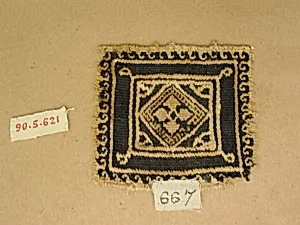
Medium
Wool, linen; tapestry weave
Dimensions
Max. H. 2 3/8 in. (6.1 cm) Max. W. 2 3/16 in. (5.5 cm)
Classification
Textiles
Department
Islamic Art
Museum
Metropolitan Museum of Art, New York, NY
Credit
Gift of George F. Baker, 1890
Accession Number
90.5.621
Rights
Public Domain
Art Historical Context
This exquisite *Textile Fragment*, dating to the 3rd–4th century, offers a glimpse into the sophisticated textile traditions of the early Islamic world. Crafted wool and linen using tapestry weave—a labor-intensive technique where colored weft threads are woven back and forth to form intricate patterns without floats—this small piece (just 2⅜ × 2⅙ inches) likely originated from garments, furnishings, or ceremonial objects in regions like Egypt or the Near East. Such fragments are rare survivors, preserved by the arid climates of these areas, and highlight the era's mastery of weaving as both a practical craft and an artistic medium. Housed in the Metropolitan Museum of Art's Department of Islamic Art, this artifact underscores the cultural continuity from Late Antiquity into the Islamic period. Tapestry weaves were prized for their durability and vivid designs, often featuring geometric motifs or figures that reflected daily life, trade, and symbolic beliefs. Donated in 1890 by George F. Baker, it exemplifies early collecting efforts that brought ancient wonders to modern audiences. Though tiny, this fragment speaks volumes about ancient ingenuity—imagine the skilled hands that wove it amid bustling workshops, contributing to a vibrant textile trade that connected civilizations. A testament to enduring artistry!