
Textile Fragment
Unknown Artist
5th–6th century
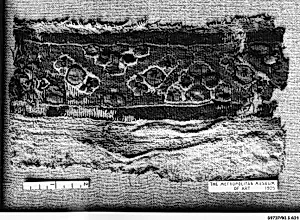
Medium
Wool, linen; plain weave, tapestry weave
Dimensions
Max. H. 8 7/16 in. (21.5 cm) Max. W. 4 7/8 in. (12.4 cm)
Classification
Textiles
Department
Islamic Art
Museum
Metropolitan Museum of Art, New York, NY
Credit
Gift of George F. Baker, 1890
Accession Number
90.5.631
Rights
Public Domain
Art Historical Context
This delicate *Textile Fragment* from 5th–6th century offers a glimpse into the sophisticated textile traditions of late antiquity. Crafted from wool and linen using plain weave for the foundation and tapestry weave for decorative motifs, it measures just 8 7/16 by 4 7/8 inches—likely a surviving piece from a larger garment, curtain, or furnishing. Donated to the Metropolitan Museum of Art in1890 by George F Baker, it now resides in the Islamic Art department, highlighting the enduring legacy of weaving techniques that bridged pre-Islamic and early Islamic cultures. The use of tapestry weave, where colored weft threads are woven over the warp to create patterns without floating yarns, was a masterful method for producing vibrant, durable designs. Common in regions like Egypt, Syria, and Persia during this era, such textiles adorned daily life and reflected cultural exchanges along ancient trade routes. Wool provided warmth and colorfastness, while linen added strength, making these fragments remarkably resilient over 1,500 years. As a testament to anonymous artisans' skill, this piece underscores textiles' role as accessible art forms—affordable yet expressive. Visitors can appreciate how such humble materials preserved stories of craftsmanship amid the rise of Islam, inviting us to marvel at history's tactile threads.