
Textile Fragment
Unknown Artist
5th century
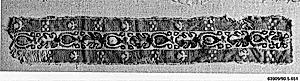
Medium
Wool, linen; tapestry weave
Dimensions
Max. H. 15 1/2 in. (39.4 cm) Max. W. 2 1/2 in. (6.4 cm wide)
Classification
Textiles
Department
Islamic Art
Museum
Metropolitan Museum of Art, New York, NY
Credit
Gift of George F. Baker, 1890
Accession Number
90.5.651
Rights
Public Domain
Art Historical Context
This delicate textile fragment, dating to the 5th, offers a glimpse into the sophisticated weaving traditions of the Late Antique world, now housed in the Metropolitan Museum of Art's Islamic Art department. Craft from wool and linen in a tapestry weave—a technique where colored weft yarns are woven discontinuously to create intricate patterns—this narrow strip (max. 15½ in. high by 2½ in. wide) survives as a testament to early textile production in regions that would later flourish under Islamic influence, such as Egypt or the Near East. Tapestry weave was prized for its durability and ability to depict vivid motifs, often drawing from Hellenistic, Sassanian, or Coptic styles. Though the specific designs on this fragment are not detailed, such pieces typically featured animal, floral, or geometric elements, blending functionality with artistry for garments, hangings, or furnishings. Its preservation highlights the technical mastery of ancient weavers, who dyed yarns vibrantly using natural sources. A generous gift from George F. Baker in 1890, this fragment bridges pre-Islamic craftsmanship with the opulent textile heritage of Islamic culture, reminding visitors how everyday materials carried profound cultural stories across centuries.