
Textile Fragment
Unknown Artist
4th–5th century
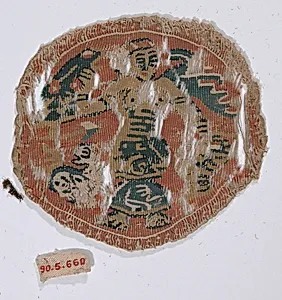
Medium
Wool, linen; tapestry weave
Dimensions
Max. H. 3 1/4 in. (8.3 cm) Max. W. 3 1/4 in. (8.3 cm)
Classification
Textiles
Department
Islamic Art
Museum
Metropolitan Museum of Art, New York, NY
Credit
Gift of George F. Baker, 1890
Accession Number
90.5.660
Rights
Public Domain
Art Historical Context
This delicate *Textile Fragment*, dating to the 4th–5th century, offers a glimpse into the sophisticated textile arts of the early medieval Islamic world. Crafted wool and linen in a weave—a technique where colorful weft yarns are woven discontinuously to create intricate patterns—this small square (just 3¼ inches on each side) is likely a surviving piece from a larger garment, curtain, or furnishing. Such fragments were common in regions like Egypt or the Near East, where weaving flourished amid cultural exchanges between Byzantine, Sassanian, and emerging Islamic influences. The use of tapestry weave highlights the era's technical mastery, allowing artisans to produce vivid, pictorial designs without wasting yarn. Wool provided durability and rich dyes, while linen added a crisp texture, making these textiles prized for both daily use and elite decoration. Though the artist remains unknown, this fragment exemplifies the continuity of Late Antique traditions into early Islamic material culture, where textiles served as portable art forms symbolizing status and spirituality. Generously gifted to the Metropolitan Museum of Art in 1890 by George F. Baker, it now resides in the Department of Islamic Art, inviting visitors to appreciate the fragility and beauty of ancient handiwork preserved through centuries.