
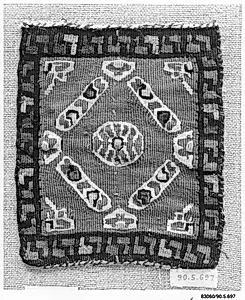
Textile Fragment
Unknown Artist
6th century
Medium
Wool, linen; tapestry weave
Dimensions
Max. H. 4 7/16 in. (11.2 cm) Max. W. 3 3/4 in. (9.5 cm)
Classification
Textiles
Department
Islamic Art
Museum
Metropolitan Museum of Art, New York, NY
Credit
Gift of George F. Baker, 1890
Accession Number
90.5.697
Rights
Public Domain
Art Historical Context
This delicate Textile Fragment, dating to the 6th, offers a glimpse into the sophisticated textile traditions of the late antique world, just before the rise of Islam. Crafted from wool and linen in a tapestry weave—a technique where colorful weft threads are woven over a linen warp to create a dense, pictorial surface—this small piece (measuring just 4 7/16 by 3 3/4 inches) likely originated in regions like Egypt or the Near East, areas pivotal to early Islamic artistic heritage. Such fragments were often parts of garments, furnishings, or ceremonial hangings, valued for their durability and vibrant designs. Tapestry weave was a hallmark of ancient Mediterranean and Near Eastern craftsmanship, allowing artisans to produce intricate patterns without relying on dyes that might fade. In the Islamic Art collection at The Metropolitan Museum of Art—acquired as a gift from George F. Baker in 1890—this fragment underscores the continuity of pre-Islamic techniques into later Islamic textiles, renowned for their geometric motifs and narrative scenes. Though worn by time, it evokes the daily artistry of a vibrant era, reminding us how textiles preserved cultural stories across centuries.