
Textile Fragment
Unknown Artist
5th–6th century
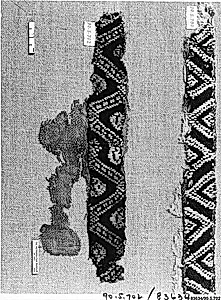
Medium
Wool, linen; tapestry weave
Dimensions
Max. H. 8 1/4 in. (21 cm) Max. W. 1 3/16 in. (3 cm)
Classification
Textiles
Department
Islamic Art
Museum
Metropolitan Museum of Art, New York, NY
Credit
Gift of George F. Baker, 1890
Accession Number
90.5.702
Rights
Public Domain
Art Historical Context
This delicate *Textile Fragment* from the 5th–6th century offers a glimpse into the masterful textile traditions of Late Antiquity, likely originating from the Eastern Mediterranean or Egypt. Crafted in wool and linen using tapestry weave—a technique where colorful weft threads are woven over a linen warp to create vibrant, pictorial designs—this small piece (just 8¼ inches high and 1⅛ inches wide) survives as a testament to everyday artistry in a pre-Islamic world. Such fragments often adorned garments, hangings, or furnishings, blending functionality with aesthetic beauty. Tapestry weave was a hallmark of Coptic and early Near Eastern textile production, prized for its durability and ability to depict motifs like animals, humans, or geometric patterns (though specifics here are lost to fragmentation). Placed in the Metropolitan Museum of Art's Islamic Art department, it bridges Late Antique craftsmanship with the rich traditions that would flourish in early Islamic culture, highlighting shared techniques across regions and eras. A generous gift from George F. Baker in 1890, this artifact invites us to marvel at the anonymous hands that wove history into fabric, preserving cultural vibrancy through centuries.