
Textile Fragment
Unknown Artist
5th–6th century
Medium
Wool, linen; tapestry weave
Dimensions
Max. H. 17 1/8 in. (43.5 cm) Max. W. 4 15/16 in. (12.5 cm)
Classification
Textiles
Department
Islamic Art
Museum
Metropolitan Museum of Art, New York, NY
Credit
Gift of George F. Baker, 1890
Accession Number
90.5.706
Rights
Public Domain
Art Historical Context
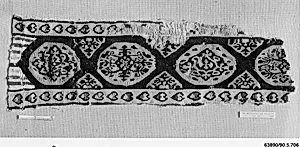
This delicate textile fragment, dating to the 5th–6th, offers a glimpse into the sophisticated weaving traditions of the early Islamic world. Crafted from wool and linen using tapestry weave—a labor-intensive technique where colored weft threads are woven discontinuously to form intricate patterns small piece (measuring just 17⅛ × 4⅞ inches) exemplifies the durability and artistry of ancient textiles. Such fragments often survived as remnants of garments, furnishings, or ceremonial objects, their vibrant dyes and precise motifs preserved against the ravages of time. Housed in the Metropolitan Museum of Art's Department of Islamic Art, this work highlights the cultural crossroads of Late Antiquity in regions like Egypt or the Near East, where pre-Islamic techniques laid the foundation for later Islamic textile arts. Tapestry weave, prized for its pictorial quality and ability to create bold, figural designs, was a hallmark of luxury production, traded along Silk Road routes and used by elites. Though the artist remains unknown, the fragment's survival underscores the rarity of these artifacts, which provide invaluable insights into daily life, trade, and aesthetic preferences of the era. A generous gift from George F. Baker in 1890, it invites visitors to appreciate how humble threads weave the rich tapestry of history.