
Textile Fragment
Unknown Artist
5th–6th century
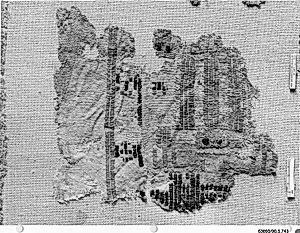
Medium
Wool, linen; plain weave, brocaded (?)
Dimensions
Max. H. 10 11/16 in. (27.1 cm) Max. W. 6 1/8 in. (15.5 cm)
Classification
Textiles
Department
Islamic Art
Museum
Metropolitan Museum of Art, New York, NY
Credit
Gift of George F. Baker, 1890
Accession Number
90.5.743
Rights
Public Domain
Art Historical Context
This delicate *Textile Fragment* from the 5th–6th offers a glimpse into the sophisticated weaving traditions of Late Antiquity, likely originating from the eastern Mediterranean or Near East. Crafted from wool and linen in a plain weave with possible brocading—a where supplementary weft threads raised patterns—it measures just 10 /16 by 6 /8 inches, hinting at its survival from a larger garment, furnishing, or ceremonial object. Such fragments are rare treasures, preserving the tactile artistry of an era bridging classical and early medieval worlds. Classified in the Metropolitan Museum of Art's Islamic Art department, this piece underscores the continuity of textile techniques into the Islamic period, where wool and linen were prized for their durability and versatility in daily life and trade. Brocading, if present, would have added luxurious texture, elevating everyday fabrics for elite use. Donated in 1890 by George F. Baker, it exemplifies how 19th-century collectors championed these artifacts, connecting us to ancient artisans whose skill in interlacing fibers produced enduring beauty. Though details like motifs are not specified, the fragment's survival speaks to the cultural reverence for textiles in pre-Islamic societies, influencing later Islamic opulence in weaving. A quiet testament to human ingenuity!