
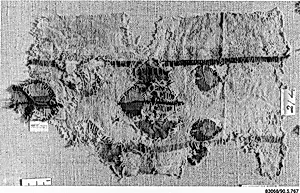
Textile Fragment
Unknown Artist
5th–6th century
Medium
Wool, linen; plain weave, tapestry weave
Dimensions
Max. H. 9 1/2 in. (24.2 cm) Max. W. 5 5/16 in. (13.5 cm)
Classification
Textiles
Department
Islamic Art
Museum
Metropolitan Museum of Art, New York, NY
Credit
Gift of George F. Baker, 1890
Accession Number
90.5.767
Rights
Public Domain
Art Historical Context
This delicate textile fragment, dating to the 5th–6th, offers a glimpse into the sophisticated weaving traditions of Late Antiquity. Housed in the Metropolitan Museum of Art's Department Islamic Art, it measures just 9½ by 5⅜ inches (24.2 by 13.5 cm) and was generously gifted by George F. Baker in1890. Though created by an unknown artist, survival as a small remnant speaks the fragility and value of ancient fabrics, likely part of a larger garment, furnishing, or ritual object from the Near East or Egypt. Crafted from wool and linen using plain weave for the ground and tapestry weave for decorative elements, the fragment showcases early technical mastery. Plain weave provided a sturdy, everyday base, while tapestry weave—where wefts are discontinuous and colored threads interlock—allowed for vibrant patterns without waste. These methods were hallmarks of pre-Islamic textile production, influencing later Islamic arts through trade and cultural exchange. For museum visitors, this piece highlights the artistry of everyday materials in a pivotal era, bridging ancient and medieval worlds. Its presence in the Islamic Art collection underscores the continuity of weaving innovations that shaped centuries of ornamental splendor.