
Textile Fragment
Unknown Artist
3rd–4th century
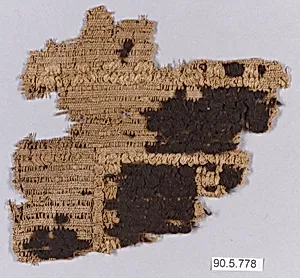
Medium
Wool, linen; plain weave, weft loop weave
Dimensions
Max. H. 4 3/4 in. (12 cm) Max. W. 4 3/8 in. (11.1 cm)
Classification
Textiles
Department
Islamic Art
Museum
Metropolitan Museum of Art, New York, NY
Credit
Gift of George F. Baker, 1890
Accession Number
90.5.778
Rights
Public Domain
Art Historical Context
This delicate textile fragment, dating to the 3rd–4th century, offers a glimpse into the sophisticated weaving traditions of Late Antiquity. Crafted from wool and linen using plain weave for a sturdy foundation and weft loop weave to create textured loops, it measures just 4 3/4 by 4 3/8 inches—likely a remnant of a larger garment, furnishing, or burial shroud.oused in the Metropolitan Museum Art's Islamic Art Department a gift from George F Baker in 1890, it reflects the enduring cultural threads connecting pre-Islamic and early Islamic worlds in regions like Egypt or the Near East. The dual weaving techniques highlight ancient artisans' ingenuity: plain weave provided durability for everyday use, while weft loops added a plush, decorative pile akin to early pile carpets or upholstery. Such methods were labor-intensive, requiring skilled hands on simple looms, and were prized in trade routes spanning the Mediterranean and beyond. As a humble survivor of millennia, this fragment underscores textiles' vital role in daily life, ritual, and commerce during a transformative era. Its preservation in a major museum collection invites us to appreciate the unsung artistry of anonymous creators whose innovations influenced centuries of fabric design.