
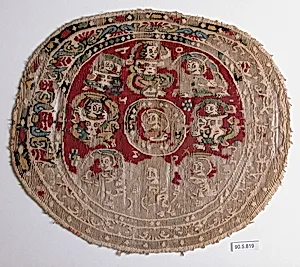
Textile Fragment
Unknown Artist
6th century
Medium
Wool, linen; tapestry weave
Dimensions
Max. H. 9 5/8 in. (24.4 cm) Max W. 8 9/16 in. (21.8 cm)
Classification
Textiles
Department
Islamic Art
Museum
Metropolitan Museum of Art, New York, NY
Credit
Gift of George F. Baker, 1890
Accession Number
90.5.819
Rights
Public Domain
Art Historical Context
This delicate Textile Fragment, dating to the 6th century, offers a glimpse into the sophisticated textile traditions of the early Islamic world—or the late antique cultures that preceded it. Woven in wool and linen using the tapestry technique, where colorful weft threads fully cover the warp yarns to create vivid patterns, this small piece (measuring just 9 5/8 by 8 9/16 inches) exemplifies durability and artistry of ancient weaving. Housed in the Metropolitan Museum of Art's Art Department, it was generously gifted by George F. Baker in 1890. Tapestry weave was a prized method in antiquity, allowing weavers to produce intricate designs without relying on dyes alone, as the materials themselves provided texture and color variation. In the 6th century, such textiles were likely produced in regions like Egypt or the Near East, where wool and linen were abundant, serving practical purposes from clothing to furnishings while showcasing cultural motifs. Though the artist remains unknown and the fragment's exact imagery is not detailed here, its survival speaks to the enduring legacy of these crafts. Visitors can appreciate how such works bridged pre-Islamic and early Islamic eras, influencing later opulent Islamic textiles renowned for their geometric and floral splendor. A true treasure of tactile history!