
Textile Fragment
Unknown Artist
3rd–4th century
Medium
Linen
Dimensions
Max. H. 3 15/16 in. (10 cm) Max. W. 3 15/16 in. (10 cm)
Classification
Textiles
Department
Islamic Art
Museum
Metropolitan Museum of Art, New York, NY
Credit
Gift of George F. Baker, 1890
Accession Number
90.5.925
Rights
Public Domain
Art Historical Context
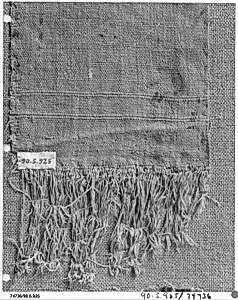
This delicate **Textile Fragment**, crafted from linen in the 3rd–4th century, offers a glimpse into the everyday artistry of the Late Antique world. Measuring just under 4 inches square, this small square survives as a testament to ancient weaving skills, likely from Egypt or the broader Mediterranean region, where linen was prized for its coolness and durability in hot climates. Placed in the Metropolitan Museum of Art's Department Islamic Art, it bridges pre-Islamic traditions with the cultural tapestry that would flourish under early Islam. Linen textiles like this were essential for clothing, furnishings, and even mummy wrappings, showcasing advanced techniques such as plain weave or tapestry, though specifics on this fragment remain elusive due to its fragmentary state. Its presence highlights the continuity of textile production across centuries, from Coptic Christian communities to Islamic eras, where such fabrics adorned homes and mosques alike. A generous gift from George F. Baker in 1890, this piece invites us to marvel at the anonymous hands behind it—artisans whose quiet mastery preserved stories in thread, connecting us to lives from 1,700 years ago.