
Textile Fragment
Unknown Artist
2nd–3rd century
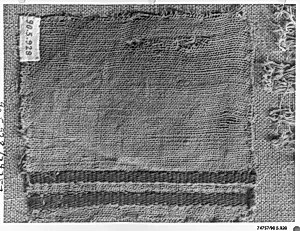
Medium
Linen, wool
Dimensions
Max. H. 3 15/16 in. (10 cm) Max. W. 3 3/8 in. (8.5 cm)
Classification
Textiles
Department
Islamic Art
Museum
Metropolitan Museum of Art, New York, NY
Credit
Gift of George F. Baker, 1890
Accession Number
90.5.928
Rights
Public Domain
Art Historical Context
This delicate *Textile Fragment*, crafted from linen and wool around the 2nd–3rd century, invites us into the world of ancient weaving traditions. Measuring just under 4 inches high and 3.5 inches wide, tiny survivor—likely a piece of clothing, furnishing, or ritual cloth—showcases the remarkable durability of textiles despite their fragility over millennia. Housed in the Metropolitan Museum Art's Department of Islamic Art, it was generously gifted by George F. Baker in1890, preserving a link to early craftsmanship in regions that would later flourish under Islamic culture. Linen, prized for its coolness and sourced from Egypt's fertile Nile Valley, paired with sturdy wool, reflects practical choices for everyday and ceremonial use in the Roman-era Near East or Mediterranean world. Weavers employed simple yet skilled techniques like tabby weaving, creating sturdy fabrics that withstood time, climate, and use. Such fragments are rare treasures, offering insights into pre-Islamic textile arts that influenced later Islamic opulence in patterns and dyes. Though the artist remains unknown, this piece highlights the anonymous mastery of ancient artisans, whose innovations in fiber and loom laid foundations for centuries of textile evolution. A quiet testament to human ingenuity!