
Textile Fragment
Unknown Artist
5th–6th century
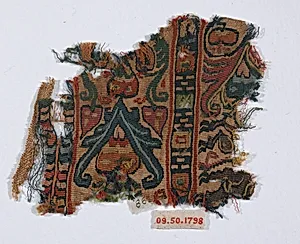
Medium
Linen, wool; tapestry weave
Dimensions
H. 4 1/8 in. (10.5 cm) W. 3 9/16 in. (9 cm)
Classification
Textiles
Department
Islamic Art
Museum
Metropolitan Museum of Art, New York, NY
Credit
Rogers Fund, 1909
Accession Number
09.50.1798
Rights
Public Domain
Art Historical Context
This delicate **Textile Fragment**, dating to the 5th–6th century, offers a glimpse into the masterful weaving traditions of the early Islamic world. Crafted linen and wool using tapestry weave—a technique where colorful weft threads are woven in discontinuous patterns to create vibrant motifs—this tiny piece (just 4 1/8 x 3 9/16 inches) survives as a testament to ancient artisans' skill. Acquired through the Rogers Fund in 1909 and housed in the Metropolitan Museum of Art's Islamic Art Department, it exemplifies the exquisite textiles produced in regions like Egypt during Late Antiquity. Tapestry weave, prized for its durability and ability to render intricate designs without waste, was a hallmark of luxury production in the pre-Islamic and early Islamic eras. These fragments often adorned garments, hangings, or mummy wrappings, blending practical utility with artistic flair. Though the specific motifs are not detailed here, such works typically featured geometric patterns, animals, or floral elements, reflecting cultural exchanges across the Mediterranean and Near East. As a classified textile in Islamic Art, this fragment highlights the continuity of craft traditions that flourished under emerging Islamic patronage. Its survival underscores the fragility and rarity of ancient fabrics, inviting us to marvel at the hands that wove beauty into everyday life over 1,500 years ago.