
Textile Fragment
Unknown Artist
early 17th century
Medium
Silk, cotton, metal wrapped thread; cut and voided velvet, brocaded
Dimensions
Textile: H. 64 in. (162.6 cm) W. 49 1/2 in. (125.7 cm) Mount: H. 68 in. (172.7 cm) W. 54 in. (137.2 cm) D. 4 in. (10.2 cm)
Classification
Textiles-Woven
Department
Islamic Art
Museum
Metropolitan Museum of Art, New York, NY
Credit
Rogers Fund, 1917
Accession Number
17.22.9
Rights
Public Domain
Tags
Art Historical Context
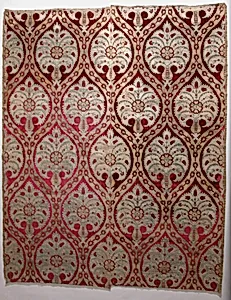
This magnificent *Textile Fragment* from the early17th century exemplifies the opulence of Islamic textile artistry, likely originating from a courtly workshop in the Ottoman, Safavid, or realms. Woven with luxurious silk and cotton threads, enhanced by shimmering metal-wrapped threads, it measures an impressive 64 by 49½ inches—large enough to have served as a luxurious hanging, curtain, or garment panel in a grand palace or mosque. Acquired through the Rogers Fund in 1917 and now housed in the Metropolitan Museum of Art's Department of Islamic Art, it showcases the era's mastery of woven textiles. The fabric employs sophisticated techniques like cut and voided velvet, where pile loops are sheared away to reveal intricate patterns, and brocading, which weaves supplementary metallic threads to create raised, luminous motifs. Dominated by flowing vines and blooming flowers—classic Islamic symbols of paradise gardens—the design evokes abundance and eternal renewal, a staple of decorative arts that avoided human or animal figures in favor of nature's splendor. Such textiles were status symbols, traded along Silk Road routes and prized by elites for their technical bravura and visual splendor. Though a fragment, it whispers of the vibrant cultural exchanges and artisanal excellence that defined the Islamic world in the 17th century, inviting us to imagine its original grandeur draped in a sultan's hall.