
Textile Fragment
Unknown Artist
5th–6th century
Medium
Wool; tapestry-woven
Dimensions
L. 25 3/4 in. (65.4 cm) W. 10 1/2 in. (26.7 cm)
Classification
Textiles
Department
Islamic Art
Museum
Metropolitan Museum of Art, New York, NY
Credit
Gift of George D. Pratt, 1930
Accession Number
30.16.11
Rights
Public Domain
Tags
Art Historical Context
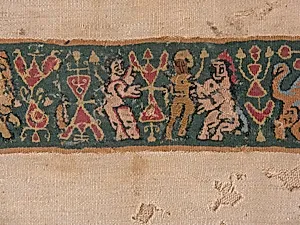
This exquisite *Textile Fragment*, dating to the 5th–6th century, a rare glimpse into the sophisticated textile arts of the late ancient Near East. Crafted wool using the tapestry-weave technique—a labor-intensive method where colored wefts are woven discontinuously to create vivid, pictorial designs—it measures 25 3/4 by 10 1/2 inches. The presence of human figures, as indicated by its tags, suggests narrative or decorative motifs typical of the era, showcasing the weavers' skill in rendering dynamic forms on a portable yet durable medium. In the Department of Islamic Art at the Metropolitan Museum of Art, this fragment highlights the cultural continuum between late antiquity and early Islam. Textiles like this were essential for clothing, furnishings, and trade across Egypt, Syria, and Persia, where wool's availability made it ideal for vibrant, long-lasting pieces. Tapestry weaving allowed for complex color blocking and figural representation, bridging pagan, Christian, and emerging Islamic iconographies. A generous gift from George D. Pratt in 1930, this artifact underscores the enduring allure of ancient fabrics, which survived centuries in arid tombs or arid climates. It invites visitors to appreciate the anonymous artisans whose intricate work adorned daily life and transcended time.