
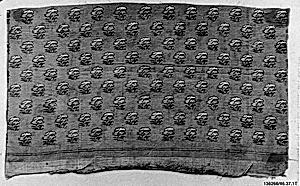
Textile Fragment
Unknown Artist
18th century
Medium
Silk, cotton, and metal wrapped thread; brocaded
Dimensions
H. 4 in. (10.2 cm) W. 10 in. (25.4 cm)
Classification
Textiles-Woven
Department
Islamic Art
Museum
Metropolitan Museum of Art, New York, NY
Credit
Gift of the Museum of the Cranbrook Academy of Art, 1946
Accession Number
46.37.1t
Rights
Public Domain
Art Historical Context
This exquisite textile fragment from the 18th century exemplifies the opulent woven traditions of Islamic art. Crafted from silk, cotton, and metalrapped threads using the brocading technique, measures a modest 4 by 10 inches, suggesting it is a surviving piece from a larger garment, furnishing, or ceremonial textile. Housed in the Metropolitan Museum of Art's Art Department, it was generously gifted by the Museum of the Cranbrook Academy Art in 1946Brocading, a sophisticated weaving method, involves inserting supplementary weft threads—often luxurious metal-wrapped ones—over a ground weave to create raised, shimmering patterns. This technique, prominent in Islamic textile production during the 18th century, highlighted the skill of artisans in regions like the Ottoman Empire, Safavid Iran, or Mughal India. The combination of shimmering silk and metallic threads would have caught the light beautifully, evoking wealth and refinement. In the Islamic world, such textiles held profound cultural significance, adorning elite clothing, mosque hangings, and trade goods along the Silk Road. Though the exact motifs are not detailed here, fragments like this preserve the ingenuity of anonymous weavers, offering a tactile glimpse into a vibrant era of artistic exchange and technical mastery. Visitors, imagine the fragment's gleam under candlelight in a grand palace!