
Textile Fragment
Unknown Artist
4th–5th century
Medium
Wool
Dimensions
H. 15 1/2 in. (39.4 cm) W. 5 1/4 in. (13.3 cm)
Classification
Textiles-Woven
Department
Islamic Art
Museum
Metropolitan Museum of Art, New York, NY
Credit
Rogers Fund, 1946
Accession Number
46.70
Rights
Public Domain
Art Historical Context
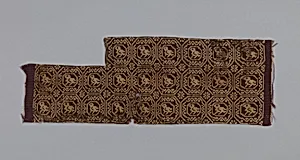
This delicate wool textile fragment, dating to the 4th–5th century, a glimpse into the sophisticated weaving traditions of the early Islamic world. Housed in the Metropolitan Museum Art's Islamic Art Department it measures a modest 15½ by 5¼ inches (39.4 × 13.3 cm) and was acquired the Rogers Fund in 6. As a woven textile, it exemplifies the durability and versatility of wool, a favored medium for garments, furnishings, and ritual objects in antiquity. Crafted by an unknown artist, this fragment originated from regions like Egypt, Syria, or Persia, where advanced loom techniques produced intricate patterns for trade and daily life. During this pre-Islamic era transitioning into early Islamic culture, weavers mastered tapestry and plain weaves, often incorporating geometric motifs or figural designs dyed with natural pigments. Such textiles were prized commodities along Silk Road routes, reflecting cultural exchanges between Byzantine, Sasanian, and emerging Islamic societies. Today, surviving fragments like this one are invaluable, preserving techniques lost to time and illuminating the artistry of everyday makers. They remind us how textiles wove together history, economy, and identity in the ancient Near East.