
Textile Fragment
Unknown Artist
15th century
Medium
Silk; lampas
Dimensions
Textile: H. 10 1/4 in. (26 cm) W. 14 5/8 in. (37.1 cm)
Classification
Textiles-Woven
Department
Islamic Art
Museum
Metropolitan Museum of Art, New York, NY
Credit
Gift of Clara Waldeck, in memory of her husband, Hans Waldeck, 1981
Accession Number
1981.372
Rights
Public Domain
Tags
Art Historical Context
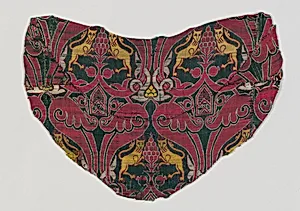
This exquisite 15th-century silk textile fragment, woven in the lampas technique, hails from the Islamic world and showcases the era's masterful textile artistry. Measuring just 10¼ by 14⅝ inches, it survives as a precious remnant, likely from a larger garment, hanging, or ceremonial object. Housed in the Metropolitan Museum of Art's of Islamic Art (gift of Clara Waldeck in memory of her husband, Hans Wal, 1981), it exemplifies the opulence of Mamluk or Timurid workshops, where silk lampas—featuring a ground weave combined with a supplementary patterned weft—created rich, durable designs that shimmered with light. The fragment's motifs, including majestic lions, hold profound cultural symbolism. In Islamic art, lions often represented strength, royalty, and protection, echoing Persian and Central Asian traditions where such beasts adorned royal tents and elite attire. The intricate weaving demanded skilled labor, blending metallic threads or dyed silks for vivid contrast, a testament to the trade routes that funneled luxurious fabrics from Asia to Europe. Though incomplete, this piece invites us to imagine the vibrant courts of the 1400s, where textiles were status symbols rivaling gold. Its preservation offers a tactile glimpse into a sophisticated craft that influenced global design for centuries.