
Textile Fragment
Unknown Artist
16th–17th century
Medium
Silk, metal thread
Dimensions
H. 21 in. (53.3 cm) W. 19 in. (48.3 cm)
Classification
Textiles
Department
Islamic Art
Museum
Metropolitan Museum of Art, New York, NY
Credit
Gift of Nanette B. Kelekian, in honor of Olga Raggio, 2002
Accession Number
2002.494.694
Rights
Public Domain
Art Historical Context
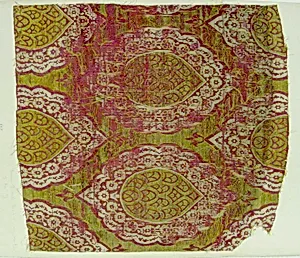
This exquisite *Textile Fragment* from the 16th–17th offers a glimpse into the opulent world of Islamic textile arts. Crafted from lustrous silk woven with shimmering metal threads—likely gold or silver—it measures 21 by 19 inches, suggesting it was once part of a larger garment curtain, or ceremonial hanging. Housed in the Metropolitan Museum of Art's Department Islamic Art, this piece was generously gifted by Nanette B. Kelekian in honor of Olgaaggio in 2002. In the Islamic world during the Ottoman, Safavid, or Mughal eras, textiles like this were symbols of prestige and piety, often produced in royal workshops or by master weavers. The use of silk provided a soft, radiant base, while metal threads added a regal gleam, reflecting advanced techniques such as lampas weaving or brocading. These methods allowed intricate patterns to emerge, blending functionality with artistry in items traded across Eurasia. Though incomplete, the fragment preserves the era's masterful craftsmanship, highlighting how textiles served as portable wealth and cultural ambassadors. Visitors can appreciate how such works bridged courts, mosques, and markets, embodying the ingenuity of anonymous artisans whose legacies endure in museum collections.