
Textile Fragment
Unknown Artist
late 17th century
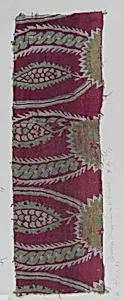
Medium
Silk
Dimensions
H. 5 in. (12.7 cm) W. 15 in. (38.1 cm)
Classification
Textiles
Department
Islamic Art
Museum
Metropolitan Museum of Art, New York, NY
Credit
Gift of Nanette B. Kelekian, in honor of Olga Raggio, 2002
Accession Number
2002.494.739
Rights
Public Domain
Art Historical Context
This delicate silk textile fragment, dating to the late 17 century, offers a tantalizing glimpse into the opulent world of Islamic art. Housed in the Metropolitan Museum of Art's Department Islamic Art, it measures just 5 by 15 inches, suggesting it is a surviving piece from a larger garment, curtain, or ceremonial object. During this era, Islamic artisans across regions like the Ottoman Empire and Safavid Persia in textile production, creating luxurious fabrics that symbolized wealth, status, and craftsmanship. Crafted from silk—a medium highly prized for its luster, durability, and association with the Silk Road trade—the fragment exemplifies the technical mastery of Islamic weavers. Techniques such as lampas weaving or brocading, common in the period, likely produced intricate patterns that blended floral motifs, geometric designs, and arabesques, reflecting the era's fusion of artistic innovation and spiritual symbolism. Silk's sheen would have caught the light in palace halls or during festive occasions, evoking the splendor of courtly life. As a gift to the Met in 2002 by Nanette B. Kelekian in honor of Olga Raggio, this fragment preserves a fragment of history, inviting us to ponder the skilled hands behind it and the vibrant cultures it represents. Though its full design is now partial, it stands as a testament to the enduring beauty of Islamic textiles.