
Textile Fragment
Unknown Artist
16th–17th century
Medium
Silk
Dimensions
H. 18 in. (45.7 cm) W. 4 5/8 in. (11.7 cm)
Classification
Textiles
Department
Islamic Art
Museum
Metropolitan Museum of Art, New York, NY
Credit
Gift of Nanette B. Kelekian, in honor of Olga Raggio, 2002
Accession Number
2002.494.753
Rights
Public Domain
Art Historical Context
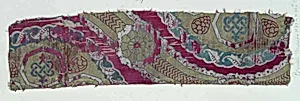
This exquisite silk textile fragment, dating to the 16th–17th century, offers a glimpse into the masterful world of Islamic textile arts. Housed in the Metropolitan Museum of Art's Department of Islamic Art, this strip—measuring 18 inches high and just 4⅝ inches wide—likely originated from a larger garment, sash, or ceremonial textile. Produced during a golden age of Islamic craftsmanship, when empires like the Safavid in Persia and the Ottoman in Turkey flourished, such fragments showcase the era's obsession with luxurious fabrics traded along the Silk Road. Silk, as the medium here, was a prized luxury symbolizing wealth and status. Weavers employed sophisticated techniques like lampas or brocading to create intricate patterns, often featuring floral motifs, arabesques, or geometric designs that reflected Islamic artistic principles of harmony and repetition. Though the artist remains unknown, the fragment's survival highlights the durability and beauty of these textiles, which adorned royal courts, mosques, and elite wardrobes. Gifted to the Met in 2002 by Nanette B. Kelekian in honor of Olga Raggio, this piece invites us to ponder the skilled hands behind it—anonymous artisans whose work bridged cultures and centuries, preserving a vibrant thread of history.