
Textile Fragment
Unknown Artist
probably 17th century
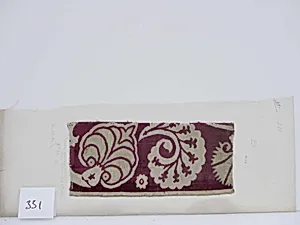
Medium
Silk, metal thread
Dimensions
H. 14 1/8 in. (35.9 cm) W. 6 3/8 in. (16.2 cm)
Classification
Textiles
Department
Islamic Art
Museum
Metropolitan Museum of Art, New York, NY
Credit
Gift of Nanette B. Kelekian, in honor of Olga Raggio, 2002
Accession Number
2002.494.756
Rights
Public Domain
Art Historical Context
This exquisite *Textile Fragment*, likely from the 17th, hails from the rich tradition of Islamic art and showcases the mastery of silk weaving combined with shimmering metal threads. Measuring just 14⅛ × 6⅜ inches, this narrow strip preserves a glimpse of opulent craftsmanship, where soft silk provided a luxurious base and metallic yarns—often gold or silver—added radiant, jewel-like gleam. Such materials were prized in the Islamic world for their ability to catch the light, evoking divine splendor in everything from royal garments to mosque furnishings. In the 17th century, during the height of empires like the Ottoman and Safavid, textiles were a pinnacle of artistic expression, rivaling painting and architecture in prestige. Weavers employed complex techniques like lampas weaving or brocading, interweaving metal threads to create intricate patterns that symbolized wealth, piety, and cultural sophistication. Though the full design is fragmentary, it hints at the floral motifs or geometric arabesques typical of the era, reflecting Islam's aniconic aesthetic that emphasized harmony and infinity. Today, this fragile treasure at the Metropolitan Museum of Art—gifted in 2002 by Nanette B. Kelekian in honor of Olga Raggio—offers visitors a tactile connection to a vanished world of skilled artisans. It reminds us how textiles, often overlooked, were vital carriers of history and beauty in Islamic culture.