
Textile Fragment
Unknown Artist
17th–18th century
Medium
Silk, metal thread
Dimensions
H. 11 3/8 in. (28.9 cm) W. 7 3/4 in. (19.7 cm)
Classification
Textiles
Department
Islamic Art
Museum
Metropolitan Museum of Art, New York, NY
Credit
Gift of Nanette B. Kelekian, in honor of Olga Raggio, 2002
Accession Number
2002.494.773
Rights
Public Domain
Tags
Art Historical Context
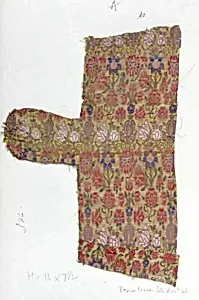
This delicate *Textile Fragment* from 17th–18th century offers a glimpse into the opulent world of Islamic textile arts. Crafted from luxurious silk woven with shimmering metal threads—likely gold or silver—it measures just 11⅜ × 7¾ inches, suggesting it survives from a larger garment, furnishing, or ceremonial object. The floral motifs, a hallmark tag of the piece, evoke the lush paradise gardens celebrated in Islamic culture, where flowers symbolize beauty, renewal, and divine abundance. In the Islamic world during this era, spanning the height of Safavid Persia and Ottoman Turkey, textiles were prized status symbols and major trade goods. Artisans employed sophisticated techniques like lampas weaving or couched metal embroidery, intertwining silk warps with metallic wefts to create rich textures and light-reflecting surfaces that caught the eye in dimly lit palaces or mosques. Such fragments highlight the era's mastery of materials, blending functionality with artistry. Today, housed in the Metropolitan Museum of Art's Islamic Art Department (gift of Nanette B. Kelekian, in honor of Olga Raggio, 2002), this piece invites visitors to marvel at the enduring elegance of anonymous creators whose work bridged East and West, influencing global design for centuries.