
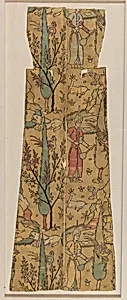
Textile Fragment Depicting a Figure in a Landscape
Unknown Artist
16th century
Medium
Silk; lampas
Dimensions
Textile: H. 40 in. (101.6 cm) W. 14 1/2 in. (36.8 cm) Mount: H. 45 1/8 in. (114.6 cm) W. 20 1/8 in. (51.1 cm) D. 7/8 in. (2.2 cm)
Classification
Textiles-Woven
Department
Islamic Art
Museum
Metropolitan Museum of Art, New York, NY
Credit
Rogers Fund, 1908
Accession Number
08.109.3
Rights
Public Domain
Tags
Art Historical Context
This exquisite 16th-century silk lampas textile fragment, housed in the Metropolitan Museum of's Islamic Art Department, a vibrant figure amidst a lush landscape teeming with symbolic motifs: men, trees, birds,, and lions. The intricate weave depicts a harmonious natural world, evoking the paradisiacal gardens central to Islamic artistic traditions, where flora, fauna, and human figures blend in rhythmic patterns. Lampas technique, a sophisticated method combining a patterned warp with a contrasting ground weave, allowed weavers to create luxurious, reversible textiles ideal for elite garments, hangings, or upholstery. Predominant in Safavid Persia during the 16th century—a golden age of textile production—this medium showcased technical mastery and access to fine silks via Silk Road trade, making such pieces status symbols for nobility. Though the artist remains unknown, the fragment's dynamic composition reflects broader Persianate influences, bridging painting and weaving traditions. Acquired through the Rogers Fund in 1908, it offers a window into the opulent material culture of the Islamic world, where nature's bounty symbolized divine abundance and eternal beauty. (198 words)