
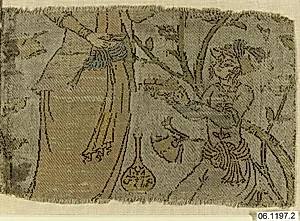
Textile Fragment Depicting Figures in a Landscape
Unknown Artist
dated A.H. 1008/1599–1600 CE
Medium
Silk, metal wrapped thread; lampas
Dimensions
Textile: H. 7 in. (17.8 cm) W. 4 1/2 in. (11.4 cm) Mount: H. 16 in. (40.6 cm) W. 22 in. (55.9 cm)
Classification
Textiles-Woven
Department
Islamic Art
Museum
Metropolitan Museum of Art, New York, NY
Credit
Rogers Fund, 1906
Accession Number
06.1197.2
Rights
Public Domain
Tags
Art Historical Context
This exquisite textile fragment, dated A.H. 1008 (1599–1600 CE), hails from the Islamic world during a golden age of artistic patronage, likely the Safavid Empire in Persia. Measuring just 7 by 4½ inches, it captures figures—possibly men—in a lush landscape, evoking the intricate storytelling of Persian miniature paintings translated into woven form. Such motifs symbolized harmony between humans and nature, often adorning elite garments or ceremonial hangings for courtly settings. Crafted in lampas weave—a sophisticated technique using silk ground yarns interspersed with metal-wrapped threads for shimmering gold and silver effects—this piece exemplifies luxury textile production. Lampas allowed complex patterns to "float" over the fabric, creating depth and opulence prized by rulers and nobility. The metallic threads not only enhanced visual splendor but also signified wealth and status in Ottoman and Safavid societies. Preserved in the Metropolitan Museum of Art's Islamic Art Department through the Rogers Fund (1906), this fragment offers a rare glimpse into 16th-century weaving mastery. Though small, it reflects the era's fusion of technical innovation and poetic imagery, inviting visitors to imagine it as part of a grand robe or wall hanging.