
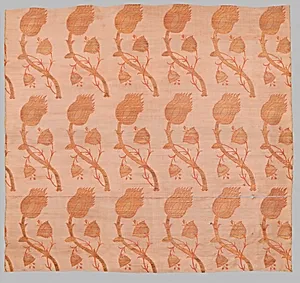
Textile Fragment with a Repeating Pattern of Interlocked Tulips and Poppies
Unknown Artist
ca. 1628–58
Medium
Silk, metal wrapped thread; plain weave, brocaded
Dimensions
Textile: H. 27 1/2 in. (69.9 cm) W. 29 1/2 in. (74.9 cm) Mount: H. 31 3/16 in. (79.2 cm) W. 33 1/4 in. (84.5 cm) D. 1 1/4 in. (3.2 cm) Wt. 22 lbs. (10 kg)
Classification
Textiles-Brocades
Department
Islamic Art
Museum
Metropolitan Museum of Art, New York, NY
Credit
The Alice and Nasli Heeramaneck Collection, Gift of Alice Heeramaneck, 1982
Accession Number
1982.477
Rights
Public Domain
Tags
Art Historical Context
This exquisite textile fragment, dating to around 1628–58, showcases the opulence of Safavid-era Persian weaving from the Islamic world. Woven in silk with luxurious metal-wrapped threads on a plain weave ground, it features a brocaded technique where supplementary wefts create a vibrant repeating pattern of interlocked tulips and poppies. about 27½ by 29½ inches, this fragment likely originated from a larger luxurious textile, such as a garment, curtain, or ceremonial hanging, prized for its shimmering metallic highlights that catch the light like jewelry. Tulips and poppies were beloved motifs in 17th-century Persian art, symbolizing paradise gardens and the fleeting beauty of life—the tulip evoking perfection, the poppy transience. Brocading, a complex process requiring skilled looms and artisans, elevated such fabrics to status symbols in royal courts, often exported across Asia and Europe. This piece reflects the Safavid dynasty's artistic peak, blending technical mastery with poetic floral designs that avoided figurative imagery in line with Islamic traditions. Now in the Metropolitan Museum of Art's Islamic Art Department, thanks to the Alice and Nasli Heeramaneck Collection, it invites us to marvel at the weavers' ingenuity and the enduring allure of these blooming patterns.