
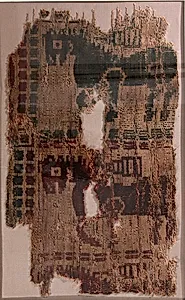
Textile Fragment with Horses
Unknown Artist
7th–9th century
Medium
Wool, cotton; taqueté
Dimensions
Textile: H. 13 1/2 in. (34.3 cm) W. 8 1/2in. (21.6cm) Mount: H. 17 5/8 in. (44.8 cm) W. 11 7/8 in. (30.2 cm) D. 1 1/4 in. (3.2 cm)
Classification
Textiles
Department
Islamic Art
Museum
Metropolitan Museum of Art, New York, NY
Credit
Rogers Fund, 1948
Accession Number
48.43
Rights
Public Domain
Art Historical Context
This exquisite *Textile Fragment with Horses*, dating to the 7th–9th century, offers a glimpse into the vibrant of early Islamic textile production. Likely woven in Egypt or the Near East during the formative centuries of Islam, this small wool and cotton piece (13½ × 8½ in.) features dynamic horse motifs, a popular symbol of speed, nobility, and power in the region's art. Such fragments, preserved through the Rogers Fund at The Metropolitan Museum of Art, survive from garments, hangings, or tents, highlighting textiles' role as luxury goods traded across empires. The fragment's standout feature is its *taqueté* weave—a sophisticated weft-faced compound twill technique prized for its durability and ability to create bold, reversible patterns with minimal yarn. Common in Coptic and early Islamic workshops, *taqueté* allowed artisans to produce intricate designs efficiently, blending local traditions with emerging Islamic aesthetics. The horses, rendered in rhythmic procession, reflect the era's fascination with equestrian culture amid conquests and caravan routes. As a testament to Islamic art's technical mastery, this artifact underscores how textiles bridged cultures—from Byzantine influences to Abbasid innovation—serving both daily life and elite status. Visitors, marvel at how such a modest fragment evokes the thunder of hooves across ancient deserts!