
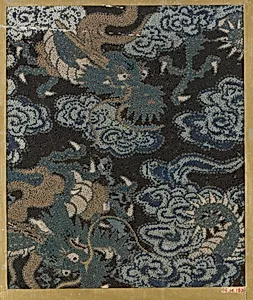
Textile fragment with pattern of three-clawed dragons in clouds
Unknown Artist
18th–19th century
Medium
Silk
Dimensions
9 x 7 1/2 in. (22.86 x 19.05 cm)
Classification
Textiles-Embroidered
Culture & Period
Japan · Edo (1615–1868)
Department
Asian Art
Museum
Metropolitan Museum of Art, New York, NY
Credit
Gift of Mr. and Mrs. H. O. Havemeyer, 1896
Accession Number
96.14.183
Rights
Public Domain
Tags
Art Historical Context
This exquisite silk textile fragment, embroidered with a dynamic pattern of three-clawed dragons through swirling clouds, hails from Japan's Edo period (1615–1868), the 18th–19th. Measuring just 9 x 7½ inches, it likely originated as part of a larger garment, screen, or decorative hanging, showcasing the era's mastery of luxurious textiles. During the Edo period, a time of relative peace and economic prosperity under the Tokugawa shogunate, silk embroidery flourished as a symbol of refinement among the merchant and samurai classes. The dragons, rendered with fluid grace and intricate stitching, embody potent Japanese cultural motifs. In East Asian lore, dragons represent imperial power, control over water and weather, and auspicious forces, often depicted amid clouds to evoke the divine realm. The three-clawed variety suggests a stylized, possibly imperial or noble association, achieved through fine silk threads in vibrant colors and subtle shading techniques like satin and chain stitches. This fragment highlights the technical virtuosity of anonymous Edo artisans, who blended functionality with artistry. A generous gift to the Metropolitan Museum of Art from Mr. and Mrs. H. O. Havemeyer in 1896, this piece invites visitors to appreciate the enduring elegance of Japanese textile traditions.