
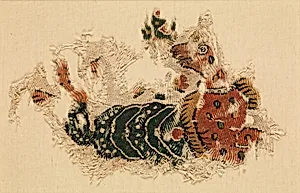
Textile Fragment with Scorpion
Unknown Artist
ca. 9th century
Medium
Wool and linen; tapestry woven
Dimensions
L. 4 1/2 in. (11.4 cm) W. 6 1/2 in. (16.5 cm) mounted and framed
Classification
Textiles
Department
Islamic Art
Museum
Metropolitan Museum of Art, New York, NY
Credit
Bequest of Carolyn Kane, 2015
Accession Number
2015.796.6
Rights
Public Domain
Tags
Art Historical Context
This delicate textile fragment, titled *Textile Fragment with Scorpion*, to around the 9th century originates from the Islamic world. Measuring just 4½ by 6½ inches, it captures a striking scorpion motif, rendered with precision on a wool and linen ground. Housed in the Metropolitan Museum of Art's Islamic Department, it entered the collection through the 2015 bequest of Carolyn Kane, offering a glimpse into the refined craftsmanship of early medieval Islamic textiles. Crafted using the tapestry weave technique, the piece interlaces colorful weft threads to form a dense, pictorial pattern without underlying floats—a labor-intensive method prized for its durability and vividness. Wool provided rich hues, while linen added strength, making such fragments ideal for garments, furnishings, or ceremonial objects. This small survival hints at larger, vibrant textiles that adorned daily life. In Islamic art of the Abbasid era, animal motifs like the scorpion held cultural resonance, possibly evoking protection or the natural world observed in arid regions. Its survival underscores the artistry of anonymous weavers, whose work bridged Byzantine, Persian, and local traditions, enriching our understanding of 9th-century material culture.