
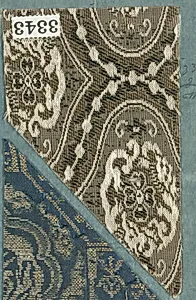
Textile Sample in Sample Book
Unknown Artist
19th century
Medium
Silk
Dimensions
4 1/2 × 2 1/2 in. (11.4 × 6.4 cm)
Classification
Textiles-Woven
Culture
Japan
Department
Asian Art
Museum
Metropolitan Museum of Art, New York, NY
Credit
Rogers Fund, 1909
Accession Number
09.50.3343
Rights
Public Domain
Art Historical Context
This delicate silk textile sample, housed in a 19th Japanese sample book, offers a glimpse into the bustling world of Edo- and early Meiji-period commerce. Measuring just 4½ × 2½ inches, this woven fragment from the Metropolitan Museum of Art's Art collection was likely part of a merchant's portfolio, used to showcase high-quality fabrics to potential buyers. Acquired through the Rogers Fund in 9, it exemplifies Japan's renowned silk production, a cornerstone of its economy during a time of rapid modernization. Woven silk held immense cultural significance in Japan, where textiles adorned kimonos that conveyed social status, seasons, and artistry. The intricate weaving techniques—often involving complex looms—produced luxurious patterns prized both domestically and, increasingly, abroad as Japan opened to global trade post-1853. Though the artist remains unknown, such samples highlight the anonymous mastery of skilled weavers, particularly from regions like Kyoto's Nishijin district. Today, this unassuming piece invites us to appreciate the fusion of utility and elegance in everyday Japanese craft, bridging art and industry in a transformative era.