
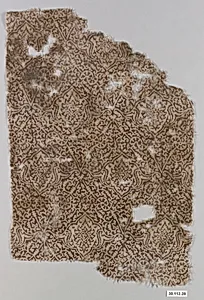
Textile with Arabesque and Palmette Design
Unknown Artist
14th century
Medium
Cotton, plain weave; block-printed, mordant dyed
Dimensions
L. 9 3/8 in. (23.9 cm) W. 12 5/8 in. (32.1 cm)
Classification
Textiles-Painted and/or Printed
Department
Islamic Art
Museum
Metropolitan Museum of Art, New York, NY
Credit
Purchase, V. Everit Macy Gift, 1930
Accession Number
30.112.28
Rights
Public Domain
Art Historical Context
This exquisite 14th-century textile fragment, featuring intricate arabesque and palmette designs offers a window into the refined artistry of Islamic decorative traditions. Crafted from cotton weave, it measures just 9⅜ by 12⅝ inches, suggesting it may have adorned a small garment, pouch, or furnishing. The motifs—swirling vines, floral palmettes, and rhythmic arabesques—exemplify the non-figural patterns central to Islamic art, evoking paradise gardens and infinite harmony while adhering to aniconic principles that avoided human or animal imagery. The block-printing technique, combined with mordant dyeing, highlights remarkable technical innovation. Blocks carved with designs were inked with mordants (fixative chemicals) before printing onto the fabric, then dyed and washed to reveal vibrant colors fixed permanently to the cotton. This labor-intensive method, prevalent in regions like India and the Near East during the medieval Islamic world, allowed for repeatable, high-quality patterns affordable for both elite and everyday use. Housed in the Metropolitan Museum of Art's Islamic Art Department (acquired in 1930), this piece underscores the global influence of Islamic textiles, bridging craftsmanship and spirituality in 14th-century culture. Visitors will appreciate its delicate beauty as a testament to enduring aesthetic elegance.