
Thames Police
Medium
etching and drypoint in black
Dimensions
plate: 15.24 x 22.54 cm (6 x 8 7/8 in.) sheet: 17.78 x 24.13 cm (7 x 9 1/2 in.)
Classification
Department
CG-W
Museum
National Gallery of Art, Washington, D.C.
Credit
Rosenwald Collection
Accession Number
1943.3.8427
Rights
Public Domain
Art Historical Context
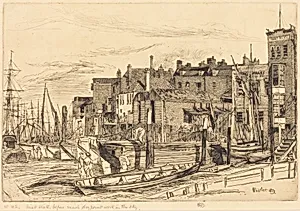
James McNeill Whistler’s *Thames Police* (1859) captures a gritty slice of Victorian London life along the bustling Thames. This intimate etching and drypoint print measuring just 15.24 x 22.54 cm on the plate, depicts boats patrolling the foggy waterway, a nod to the newly professionalized Thames River Police established in 1798 to combat smuggling, theft, and crime amid the port’s chaotic commerce. Whistler, an American expatriate in London, produced this as part of his pioneering *Thames Set*—a series of 16 etchings that romanticized the river’s everyday laborers and nocturnal moods. Whistler’s masterful use of etching (acid-etched lines for precision) combined with drypoint (direct needle scratches for rich, velvety burrs) creates a hazy, atmospheric depth, evoking the Thames’ misty ambiance. This technical innovation marked his shift toward Realism, influenced by French artists like Courbet, before his later Aestheticism and “art for art’s sake” philosophy. Housed in the National Gallery of Art’s Rosenwald Collection, the print exemplifies Whistler’s early printmaking genius, blending documentary detail with subtle artistry. A charming fact: Whistler etched directly from a rowing boat, immersing himself in the scene for authenticity. This modest yet evocative work invites visitors to ponder the hidden guardians of London’s watery lifeline.
About the Artist
James McNeill Whistler · 1834–1903
James Abbott McNeill Whistler (1834-1903) was an American-born painter and printmaker who became a leading figure in the Aesthetic Movement and pioneer of Tonalism and Japonisme. He revolutionized art by championing "art for art's sake" and treating paintings as visual equivalents of musical compositions, titling works as "arrangements," "harmonies," and "nocturnes" to emphasize formal qualities o...