
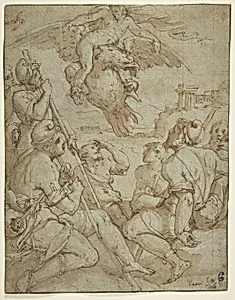
The Abduction of Ganymede
1511–74
Medium
Pen and brown ink, brush and brown wash, highlighted with white, over black chalk on blue paper. Squared in black chalk
Dimensions
9-1/8 x 7-1/16 in. (23.1 x 18 cm)
Classification
Drawings
Department
Drawings and Prints
Museum
Metropolitan Museum of Art, New York, NY
Credit
Harry G. Sperling Fund, 1983
Accession Number
1983.31
Rights
Public Domain
Tags
Art Historical Context
In the Metropolitan Museum of Art's Drawings and Prints department, Giorgio Vasari's *The Abduction of Ganym* (c. 1511–74) captures a dramatic moment from classical mythology. The drawing depicts the Trojan youth Ganymede being seized by Zeus in the form of an eagle destined to become the gods' cupbearer on Mount. Vasari, a Renaissance figure known not only as a painter and architect but also as the author of *Lives of the*, infused his works with Mannerist elegance and dynamic energy, bridging High Renaissance ideals with emerging Baroque drama. Crafted on prepared blue paper—a favored Renaissance ground for its luminous effect—this sheet measures a intimate 9-1/8 x 7-1/16 inches. Vasari began with black chalk underdrawing, refined it with precise pen and brown ink lines, added depth through brush and brown wash, and heightened forms with white gouache for sparkling highlights. The black chalk squaring indicates it was a preparatory study, likely scaled up for a larger fresco or panel, showcasing the meticulous planning behind grand commissions. Acquired through the Harry G. Sperling Fund in 1983, this drawing exemplifies 16th-century Italian draftsmanship's technical virtuosity and cultural reverence for Greco-Roman tales, inviting visitors to ponder the blend of myth, beauty, and artistic innovation.
About the Artist
Giorgio Vasari · 1511–1574
Vasari was a productive court artist and architect in Florence during the first half of the 16th century, with his primary patrons being Alessandro and Ippolito de' Medici, until 1537 with the death of Alessandro. However, he is most well known for his book "Le vite de' più eccellenti architetti, pittori, et scultori Italiani," which was first published in 1550, and once again in 1568 in an expand...