
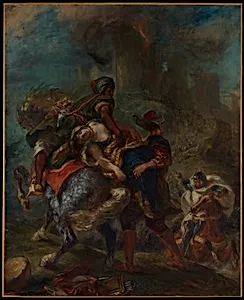
The Abduction of Rebecca
1846
Medium
Oil on canvas
Dimensions
39 1/2 x 32 1/4 in. (100.3 x 81.9 cm)
Classification
Paintings
Department
European Paintings
Museum
Metropolitan Museum of Art, New York, NY
Credit
Catharine Lorillard Wolfe Collection, Wolfe Fund, 1903
Accession Number
03.30
Rights
Public Domain
Tags
Art Historical Context
Eugène Delacroix'sThe Abduction of Rebecca (1846) captures a whirlwind of drama and motion in oil on canvas, measuring an imposing 39½ × 32¼ inches. As a cornerstone of Romanticism, Delacroix masterfully depicts a scene of abduction amid battle, with rearing horses, armored men, and a struggling woman at its heart. The tags—horses, battles, men women—evoke the raw energy of conflict, rendered with his signature loose brushwork and vibrant colors that blur the line between chaos and beauty. Inspired by Sir Walter Scott's novel *Ivanhoe*, the painting dramatizes the kidnapping of the Jewish heroine Rebecca by Templar knights during a medieval siege. Created in the mid-19th century, it reflects Romanticism's fascination with history, literature, and exotic emotion, positioning Delacroix as a rival to classical precision with his emphasis on passion and immediacy. The oil medium allows for luminous effects, from the glint of armor to the fury of dust clouds, drawing viewers into the fray. Acquired through the Catharine Lorillard Wolfe Collection in 1903, this work graces the Metropolitan Museum of Art's European Paintings department. It exemplifies Delacroix's influence on modern art, inspiring Impressionists with its bold technique and storytelling power—a thrilling window into 19th-century imagination.
About the Artist
Eugène Delacroix · 1798–1863
Eugène Delacroix (1798–1863) stands as the defining figure of French Romanticism and a pivotal bridge to modernism. Born in Charenton-Saint-Maurice near Paris, he came from distinguished lineage—his mother descended from the prestigious Oeben-Riesener furniture dynasty, while persistent speculation suggested the statesman Talleyrand may have been his biological father, a theory supported by physic...