
The Absinthe Drinker
c. 1890
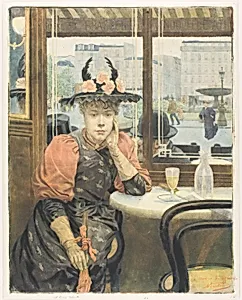
Medium
Etching in color heightened with graphite, on ivory wove paper
Dimensions
Plate: 40.6 × 32 cm (16 × 12 5/8 in.); Sheet: 42.2 × 33.6 cm (16 5/8 × 13 1/4 in.)
Classification
etching
Department
Prints and Drawings
Museum
Art Institute of Chicago
Accession Number
6567
Rights
Public Domain
Art Historical Context
In the dimly lit world of fin-de-siècle Paris,The Absinthe Drinker* by-Emmanuel Bertrand (c. 1890) captures the era's fascination with bohemian excess and urban melancholy. This evocative print depicts a solitary figure immersed in the ritual of absinthe consumption—a pale green liqueur synonymous with artistic circles, writers like Baudelaire, and painters such as Édouard Manet and Edgar Degas, who explored its themes decades earlier. By the 1890s, absinthe had become a cultural icon of decadence, often linked to hallucinations and social decline, reflecting broader anxieties about modernity and addiction in France. Crafted as a color etching heightened with graphite on ivory wove paper (plate: 40.6 × 32 cm), Bertrand's work showcases masterful printmaking techniques. Etching involves incising lines into a metal plate with acid, allowing for precise, expressive lines, while the rare use of color—likely applied à la poupée (by hand to the plate)—brings vibrant yet subdued tones to life. The graphite accents add luminous highlights, enhancing depth and texture on the smooth wove paper, a medium favored for its clarity in fine art prints. Housed in the Art Institute of Chicago's Prints and Drawings department, this piece exemplifies the technical innovation of late 19th-century French printmaking, bridging painting and graphics. It invites visitors to ponder the allure and peril of absinthe-fueled reverie, a poignant snapshot of a transformative cultural moment.