
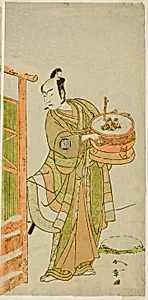
The Actor Arashi Sangoro II as Ito Kuro Disguised as Banta in the Play Izu-goyomi Shibai no Ganjitsu, Performed at the Morita Theater in the Eleventh Month, 1772
c. 1772
Medium
Color woodblock print; hosoban; right sheet of diptych
Dimensions
30.1 × 14.3 cm (11 7/8 × 5 5/8 in.)
Classification
woodblock print
Department
Arts of Asia
Museum
Art Institute of Chicago
Accession Number
86402
Rights
Public Domain
Art Historical Context
Step into the lively world of 18th-century Japanese theater this colorful woodblock print by Katsukawa Shunsho, a master of ukiyo-e, or "pictures of the floating." Titled *The Actor Arashi Sangoro as Ito Kuro Disgu as Banta in the Izu-goyomi Shibai no Ganjitsu*, created around 1772, it captures the kabuki star in a dynamic disguise from a performance at Tokyo's Morita Theater. As the right sheet of a dipt in the narrow hosoban format (30.1 × 14.3 cm), it invites viewers to imagine its companion panel, together forming a complete theatrical scene. Shunsho's yakusha-e (actor prints) revolutionized portraiture by emphasizing expressive faces, flowing robes, and dramatic poses, making stars like Arashi Sangoro accessible to everyday fans. Produced via intricate woodblock techniques—carving separate blocks for colors and details—these affordable prints democratized art during the Edo period, reflecting Japan's booming urban culture of entertainment and fashion. This piece, housed in the Art Institute of Chicago's Arts of Asia collection, offers a vivid snapshot of kabuki's golden age, where disguise and role-playing blurred art and life, captivating audiences in 1772 and enchanting us today.