
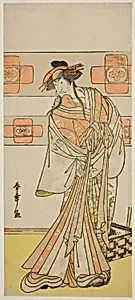
The Actor Ichikawa Monnosuke II as the Ghost of the Renegade Monk Seigen in the Play Edo no Hana Mimasu Soga, Performed at the Nakamura Theater in the Second Month, 1783
c. 1783
Medium
Color woodblock print; hosoban; center sheet of triptych
Dimensions
31.2 × 13.6 cm (12 5/16 × 5 3/8 in.)
Classification
woodblock print
Department
Arts of Asia
Museum
Art Institute of Chicago
Accession Number
3605
Rights
Public Domain
Art Historical Context
Step into the vibrant world of 18th-century Edo (modern Tokyo) with Katsukawa Shunsho's *The Actor Ichikawa Monnos II as the Ghost of Renegade Monk Seigen in the Play Edo no Hana Mimas Soga*. Created around 1783, this color woodblock print captures a dramatic moment from a kabuki performance at the Nakamura Theater.sho, a leading master of the ukiyo-e ("pictures of the floating world"), specialized in yakusha-e—striking portraits of kabuki actors—that brought the theater's glamour to everyday viewers. Here, the renowned actor Ichikawa Monnosuke II embodies the spectral monk Seigen from a popular variant of the Soga brothers revenge tale, blending supernatural drama with theatrical flair. Printed in the narrow hosoban format (31.2 × 13.6 cm), this is the center sheet of a triptych, designed to be joined with flanking panels for a panoramic stage view. The technique of woodblock printing allowed for bold colors, intricate lines, and subtle gradations (via techniques like bokashi shading), making affordable multiples that democratized art during Japan's Edo period. Shunsho's precise rendering of Monnosuke's flowing robes, fierce expression, and ghostly aura highlights his skill in conveying emotion and movement, elevating actor prints to high art. This piece reflects kabuki's cultural dominance, where ghosts and vendettas enthralled audiences, mirroring society's fascination with impermanence and spectacle. Housed in the Art Institute of Chicago's Arts of Asia collection, it offers a vivid portal to Japan's theatrical golden age.