
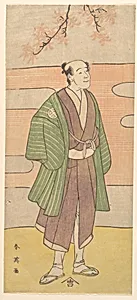
The Actor Otani Oniji III
1762–1819
Medium
Woodblock print; ink and color on paper
Dimensions
11 7/8 x 5 1/4 in. (30.2 x 13.3 cm)
Classification
Prints
Culture & Period
Japan · Edo period (1615–1868)
Department
Asian Art
Museum
Metropolitan Museum of Art, New York, NY
Credit
Henry L. Phillips Collection, Bequest of Henry L. Phillips, 1939
Accession Number
JP2895
Rights
Public Domain
Tags
Art Historical Context
Step into the vibrant world of Edo-period Japan *The Actor Otani Oniji*, a striking woodblock print by Katsukawa Shun'ei (1762–1819). This intimate portrait, measuring just 11⅞ × 5¼ inches, captures the renowned kabuki actor in a moment of dramatic intensity. Shun'ei, a of the Katsukawa school, specialized in yakusha-e—actor prints that brought the stars of the theater to everyday admirers, turning performers into cultural icons. Created during the Edo period (1615–1868), when kabuki theater flourished in urban centers like Edo (modern Tokyo), this work exemplifies ukiyo-e, the "pictures of the floating world" genre celebrating fleeting pleasures. Woodblock printing with ink and color on paper allowed for affordable, mass-produced art, making celebrity portraits accessible beyond the elite. Shun'ei's technique shines in bold lines, vivid hues, and expressive poses that convey the actor's emotional depth and stage presence, blurring the line between portraiture and performance. Housed in the Metropolitan Museum of Art's Asian Art Department from the Henry L. Phillips Collection, this print offers a window into Japan's theatrical golden age, where actors like Otani Oniji III embodied larger-than-life roles, captivating audiences and collectors alike.
About the Artist
Katsukawa Shun'ei 勝川春英 (Japanese) · 1762 –1819
Japanese, 1762–1819