
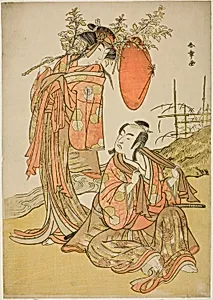
The Actors Ichikawa Monnosuke II and Segawa Kikunojo III as the Lovers Seijuro (right) and Onatsu (left), in the Elopement Scene "Michiyuki Hiyoku no Kiku-cho" (An Elopemet: Chrysanthemum-and-Butterfly Lovebirds), a Dance Interlude from Part Two of the Play Kabuki no Hana Bandai Soga (Flower of Kabuki: The Eternal Soga), Performed at the Ichimura Theater from the Twenty-fifth Day of the Fourth Month, 1781
c. 1781
Medium
Color woodblock print; aiban
Dimensions
32.5 × 28 cm (12 13/16 × 11 in.)
Classification
woodblock print
Department
Arts of Asia
Museum
Art Institute of Chicago
Accession Number
34884
Rights
Public Domain
Art Historical Context
In the vibrant world of 18th-century Edo Japan, Katsukawa Shunsho (1726–1792), a master of ukiyo woodblock prints, captured the drama of Kabuki theater in striking aiban-format print from around 1781. Titled *The Actors Ichikawa Monnosuke II and Segawaunojo III as the Seijuro (right) and Onatsu (left, it depicts a tender elopement scene—"Michiyuki Hiyoku no Kiku-cho" (Chrysanthemum-and-Butterfly Lovebirds)—from the play *Kabuki no Hana Bandai Soga*, performed at Tokyo's Ichimura Theater. Shunsho's precise lines and bold colors bring the stars to life, showcasing Monnosuke II's dashing Seijuro and Kikunojo III, a renowned onnagata (male actor specializing in female roles), as the devoted Onatsu. This artwork exemplifies the yakusha-e genre, or actor prints, which celebrated Kabuki's spectacle amid Japan's Edo-period cultural boom. Woodblock printing allowed mass production, making theater icons accessible to everyday fans. The aiban size (about 32.5 × 28 cm) offered an intimate view, highlighting intricate costumes, expressive poses, and the lovers' poetic bond—evoking themes of passion and fleeting romance central to Kabuki tales. Housed in the Art Institute of Chicago's Arts of Asia collection, Shunsho's print not only preserves a historic performance from the 25th day of the fourth month in 1781 but also reveals how art democratized celebrity culture, bridging stage and street in Japan's golden age of printmaking.