
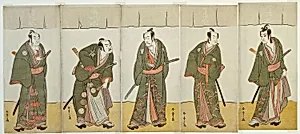
The Actors Ichikawa Monnosuke II as Karigane Bunshichi, Bando Mitsugoro I as An no Heibei, Ichikawa Danjuro V as Gokuin Sen'emon, Nakamura Sukegoro II as Kaminari Shokuro, and Sakata Hangoro II as Hotei Ichiemon (right to left), in "Gonin Otoko" (Five Chivalrous Commoners), an Interlude in Part Two of the Play Hatsumombi Kuruwa Soga (A Soga Drama on the First Festival Day in the Pleasure District), Performed at the Nakamura Theater from the First Day of the Second Month, 1780
c. 1780
Medium
Color woodblock print; hosoban; pentaptych
Dimensions
31.3 × 14.5 cm (12 5/16 × 5 3/4 in.); 31.3 × 14.1 cm (12 5/16 × 5 9/16 in.); 31.3 × 14.5 cm (12 5/16 × 5 3/4 in.); 31.3 × 14.8 cm (12 5/16 × 5 13/16); 31.3 × 14.1 cm (12 5/16 × 5 9/16 in.) (right to left)
Classification
woodblock print
Department
Arts of Asia
Museum
Art Institute of Chicago
Accession Number
109394
Rights
Public Domain
Art Historical Context
This vibrant pentaptych woodblock print by Katsukawa Shunsho captures a thrilling moment from kabuki theater in 1780 Edo (modern Tokyo). Titled *The Actors Ichikawa Monuke II as Karig Bunshichi, B Mitsugoro I as no Heibei, Ichikawa Danjuro V as Gokuin Sen'emon Nakamura Sukegoro II Kaminari Shok, and Sakata Hang II as Hotei Ichiemon (right to left), in "Gonin Otoko" (Five Chivalrous Commoners)*, it depicts five star actors in dynamic poses during an interlude from the play *Hatsumombi Kuruwa Soga*, performed at the Nakamura Theater. Shunsho, a leading ukiyo-e master of yakusha-e (actor portraits), immortalizes their exaggerated expressions, flowing robes, and signature mie stances, evoking the energy of live performance. Printed as a narrow hosoban format—five slim sheets (each about 31 x 14 cm) that join into one panoramic scene—this color woodblock exemplifies Edo-period printing techniques. Artisans carved intricate blocks for each color layer, allowing mass production of affordable art that brought kabuki glamour to everyday homes. Shunsho's precise lines and bold shading highlight the actors' individualism amid group harmony. Culturally, the print celebrates the chivalrous commoners of Soga dramas, tales of loyalty and revenge central to kabuki's appeal. It offers a window into 18th-century Japan's thriving theater scene, where stars like Ichikawa Danjuro V were celebrities, blending artistry with popular entertainment.