
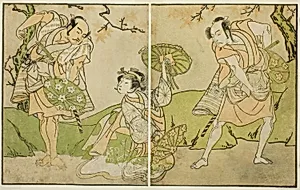
The Actors Ichikawa Somegoro (right), Segawa Kikunojo II (center), and Bando Sampachi (left), in Unidentified Roles in the Play Myoto-giku Izu no Kisewata, Performed at the Ichimura Theater in the Eleventh Month, 1770
c. 1772
Medium
Color woodblock print; from the illustrated book Yakusha Kuni no Hana (Prominent Actors of Japan)
Dimensions
17.4 × 27.8 cm (6 7/8 × 10 15/16 in.)
Classification
woodblock print
Department
Arts of Asia
Museum
Art Institute of Chicago
Accession Number
88373
Rights
Public Domain
Art Historical Context
Step into the vibrant world of 18th-century Japanese kab theater with this exquisite color woodblock print by Katsukawa Shunsho, leading master of ukiyo-e ("pictures of the floating world"). Created around 1772, it portrays three celebrated actors—Ichikawa Somegoro on the, Segawa Kikuno II in the center, and Bando Samp on the left—in unidentified roles from the play *Myoto-giku Izu no Kisewata performed at the Ichimura in Edo (modern Tokyo) during the eleventh month of 1770. Part of the illustrated book *Yakusha Kuni no Hana* (Prominent Actors of Japan), this print captures the stars' dramatic poses and elaborate costumes, immortalizing a fleeting performance. Shunsho's yakusha-e (actor prints) revolutionized the genre with their lifelike expressions, dynamic compositions, and subtle use of color, achieved through the meticulous woodblock process involving multiple carved blocks for layers of pigment. At just 17.4 × 27.8 cm, these intimate pages were affordable collectibles for fans, blending art and celebrity culture during the Edo period's theater boom. This work highlights kabuki's cultural dominance, where onnagata like Segawa Kikunojo II specialized in female roles, showcasing gender fluidity and artistic virtuosity that enthralled audiences. A true snapshot of Japan's performative heritage!