
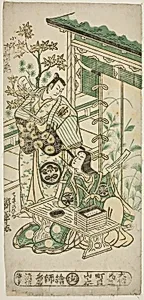
The Actors Ichimura Uzaemon VIII as Oguri Hangan and Segawa Kikunojo I as Terute no Mae in the play "Mangetsu Oguri Yakata," performed at the Ichimura Theater in the eighth month, 1747
Medium
Color woodblock print; hosoban, benizuri-e
Dimensions
32 × 15.1 cm (12 9/16 × 5 15/16 in.)
Classification
woodblock print
Department
Arts of Asia
Museum
Art Institute of Chicago
Accession Number
19260
Rights
Public Domain
Art Historical Context
Step into the vibrant world of 18th Japanese theater with this striking woodblock print by Torii Kiyonobu, a master of the Torii school renowned for yakusha-e, or actor portraits. Created in 1747, it captures Ichimura Uzaemon VIII the valiant Oguri Hangan Segawa Kikunojo I as the elegant Terute no Mae from the Kabuki play *Mangetsu Oguri Yakata*, performed at Tokyo's Ichimura Theater. The narrow hosoban format (32 × 15.1 cm) was perfect for these intimate depictions, allowing fans to collect and display images of their favorite stars. This benizuri-e, or "rose-colored print," showcases an early color woodblock technique using just pinkish-red and one other hue— a bridge between monochrome ukiyo-e and the later full-color nishiki-e masterpieces. Kiyonobu II's bold lines and dynamic poses bring the actors' expressive faces and flowing costumes to life, emphasizing their star power in Edo-period popular culture. Kabuki was a spectacle of drama, music, and gender-bending roles (like Segawa Kikunojo I, a male onnagata playing a woman), reflecting Japan's thriving urban entertainment scene. Housed in the Art Institute of Chicago's Arts of Asia collection, this print offers a window into how art fueled theater fandom, much like celebrity posters today. A testament to ukiyo-e's "floating world" spirit!
About the Artist
Torii Kiyonobu II · 1702–1752
Japanese, ca. 1702–1752