
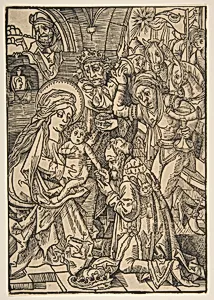
The Adoration of the Magi (Schr. 100)
15th century
Medium
Woodcut
Dimensions
sheet: 9 9/16 x 6 11/16 in. (24.3 x 17 cm)
Classification
Prints
Department
Drawings and Prints
Museum
Metropolitan Museum of Art, New York, NY
Credit
Bequest of James Clark McGuire, 1930
Accession Number
31.54.134
Rights
Public Domain
Tags
Art Historical Context
In the heart of 15th-century Germany, the late Gothic period, anonymous artists produced vibrant woodcuts like *The Adoration of the (Schr. 100 to bring sacred stories to everyday devotees. This intimate print depicts the biblical scene of the Three Wise Men presenting gifts to the infant Jesus, accompanied by the Madonna, with horses and figures evoking a lively procession. Measuring just 9 9/16 x 6 11/16 inches, it was designed for personal devotion—perhaps pinned to a wall or carried in prayer books—making religious art accessible beyond grand cathedrals. Woodcuts, carved into wooden blocks and printed with ink, revolutionized image-making around the time of Gutenberg's press. This technique allowed for mass production of affordable, monochromatic prints that could be hand-colored for added vibrancy, spreading iconography like the Adoration—a feast celebrated on Epiphany—across homes and pilgrimage sites. As part of the Metropolitan Museum of Art's Drawings and Prints collection, gifted through the Bequest of James Clark McGuire in 1930, it exemplifies early German printmaking's role in fostering piety and cultural unity amid the era's religious fervor. Today, this anonymous gem invites us to ponder how simple lines captured profound faith, bridging medieval devotion with the dawn of the Renaissance.