
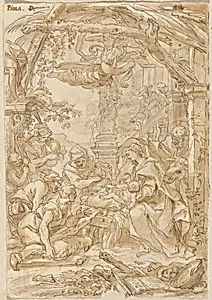
The Adoration of the Shepherds
c. 1680/1690
Medium
pen and brown ink with brown wash on laid paper
Dimensions
sheet: 31 × 21 cm (12 3/16 × 8 1/4 in.) mount: 33.7 × 23.4 cm (13 1/4 × 9 3/16 in.)
Classification
Drawing
Department
CG-E
Museum
National Gallery of Art, Washington, D.C.
Credit
Joseph F. McCrindle Endowment Fund
Accession Number
2021.17.2
Rights
Public Domain
Art Historical Context
Giovanni Battista Merano's *The Adoration of the Shepherds*, created around 1680–1690, captures a timeless biblical moment from the Nativity story: humble shepherds kneeling in awe before the infant Christ, Mary, and Joseph in a dimly lit stable. As a Genoese artist active in late 17th-century Italy, Merano embodied the dramatic flair of the Baroque era, drawing inspiration from masters like Rubens and Van Dyck. His works often pulsed with emotional intensity and dynamic compositions, reflecting the Catholic Church's push for vivid religious imagery during the Counter-Reformation. This delicate drawing, executed in pen and brown ink heightened with brown wash on laid paper (31 × 21 cm), showcases Merano's mastery of monochrome techniques. The fine ink lines define expressive figures and flowing drapery, while the wash adds subtle tonal depth, mimicking the chiaroscuro effects of oil paintings. Such preparatory sketches were vital in Baroque workshops, allowing artists to refine poses and lighting before committing to larger canvases—likely the case here, evoking a sense of divine light piercing the humble scene. Housed in the National Gallery of Art's collection through the Joseph F. McCrindle Endowment Fund, this intimate work invites visitors to appreciate the artistry behind grand altarpieces. It reminds us how a simple sheet of paper could bridge everyday devotion and monumental faith.