
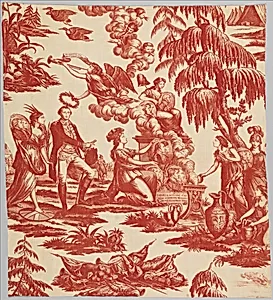
The Altar of Liberty
Unknown Artist
ca. 1785
Medium
Cotton
Dimensions
H. 33 x W. 30 1/2 inches (83.82 x 77.5 cm)
Classification
Textiles-Printed
Culture
British
Department
European Sculpture and Decorative Arts
Museum
Metropolitan Museum of Art, New York, NY
Credit
Bequest of Charles Allen Munn, 1924
Accession Number
24.109.109
Rights
Public Domain
Tags
Art Historical Context
Step into the world of 18th-century textiles with *The Altar of Liberty*, a striking cotton panel created by an unknown British artist around 1785. Measuring 33 by 30½ inches, this work belongs to the Metropolitan Museum Art's European Sculpture andative Arts collection, bequeathed by Charles Allen Munn in 1924. Classified as a printed textile, it exemplifies the era's innovative use of cotton fabrics—often block-printed or copperplate-engraved—to produce affordable, vivid imagery for homes and public display. Dated just after the American Revolution, the piece captures the fervor of newfound liberty through its central motifs: George Washington, women, and birds. Washington, the revolutionary hero, likely appears as a symbol of independence, while female figures may evoke Liberty or allegorical goddesses, and birds suggest freedom or divine favor. The "altar" title nods to neoclassical ideals, blending classical antiquity with contemporary politics in a distinctly British production—highlighting transatlantic cultural exchanges amid shifting empires. As a decorative art, *The Altar of Liberty* reveals how textiles democratized propaganda and patriotism, turning fabric into a canvas for historical narrative. Its bold prints and symbolic density make it a window into the Enlightenment's embrace of republican virtues, inviting us to ponder the global ripples of America's birth.