
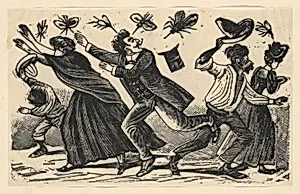
The American mosquito that just appeared in Mexico
ca. 1903
Medium
Type-metal engraving
Dimensions
Sheet: 3 1/4 × 5 1/8 in. (8.2 × 13 cm)
Classification
Prints
Department
Drawings and Prints
Museum
Metropolitan Museum of Art, New York, NY
Credit
Gift of Jean Charlot, 1930
Accession Number
30.82.24
Rights
Public Domain
Tags
Art Historical Context
José Guadalupe Posada, a pioneering Mexican printmaker, created *The American Mosquito that Just Appeared in Mexico* around 1903 using type-metal engraving, a relief printing technique that allowed for inexpensive, mass-produced broadsheets. This small print (3 1/4 × 5 1/8 in.) exemplifies Posada's signature bold, black-and-white style, characterized by stark contrasts and dynamic lines, which made his satirical works accessible to everyday people during Mexico's Porfiriato era under dictator Porfirio Díaz. The title cleverly employs the mosquito as a metaphor for an intrusive "American" presence—likely poking fun at U.S. economic or cultural influences encroaching on Mexico amid growing tensions in the early 20th century. Tags like satire, men, women, and insects suggest a humorous scene critiquing social dynamics, possibly depicting exaggerated figures reacting to this "pest." Posada's prints often lampooned the elite and foreign meddlers, blending folk art traditions with sharp political commentary. As a master of the calavera (skeleton) genre and social caricature, Posada influenced modern Mexican artists like Diego Rivera. This piece, now in the Metropolitan Museum of Art thanks to a 1930 gift from Jean Charlot, highlights the power of humble prints in sparking public discourse and preserving cultural wit.
About the Artist
José Guadalupe Posada · 1852–1913
José Guadalupe Posada (1852-1913) was a Mexican printmaker and engraver who revolutionized popular art and created some of the most iconic images in Mexican culture. Working primarily with publisher Antonio Vanegas Arroyo, he produced over 20,000 images during his career—inexpensive broadsheets sold for a penny on colored paper that made his art accessible to even the poorest workers. He transform...