
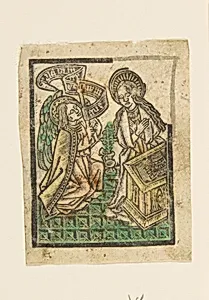
The Annunciation
ca. 1470–80
Medium
Metalcut, hand-colored in green, yellow, and red
Dimensions
plate: 2 3/8 x 1 13/16 in. (6 x 4.6 cm) sheet: 2 13/16 x 2 1/8 in. (7.1 x 5.4 cm)
Classification
Prints
Department
Drawings and Prints
Museum
Metropolitan Museum of Art, New York, NY
Credit
Bequest of James Clark McGuire, 1930
Accession Number
31.54.178
Rights
Public Domain
Tags
Art Historical Context
Step into the intimate world of late medieval devotion with *The Annunciation*, a metalcut print created by an anonymous artist from Cologne, Germany, around 1470–80. This tiny treasure captures the pivotal biblical moment when the Archangel Gabriel announces the Virgin Mary that she conceive Jesus, a scene central to Christian iconography. Rendered at just 2 3/8 x 1 13/16 inches, it was likely designed for personal prayer books or private altars, reflecting the era's deep piety in the Rhineland, a hub of artistic production amid the Late Gothic style. The artwork's rarity lies in its metalcut technique, one of the earliest intaglio print methods popular in 15th-century Germany before engraving took over. A thin metal plate was engraved with fine lines, printed on damp paper for crisp detail, then meticulously hand-colored in vibrant green, yellow, and red to evoke heavenly light and divine grace. This labor-intensive process transformed a simple print into a luminous devotional object, blending mass production with artisanal beauty. Housed in the Metropolitan Museum of Art's Drawings and Prints department through the 1930 bequest of James Clark McGuire, *The Annunciation* offers a window into Cologne's thriving print culture and the era's veneration of Mary and Gabriel. Pause to admire the delicate interplay of figures—its small scale invites close contemplation of faith's quiet miracles.