
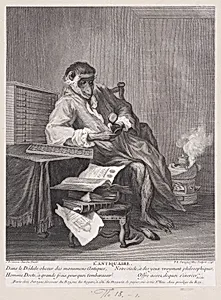
The Antiquarian
Medium
Engraving; second state of two
Dimensions
Sheet (trimmed): 12 in. × 9 1/16 in. (30.5 × 23 cm)
Classification
Prints
Department
Drawings and Prints
Museum
Metropolitan Museum of Art, New York, NY
Credit
Harris Brisbane Dick Fund, 1953
Accession Number
53.600.537
Rights
Public Domain
Tags
Art Historical Context
Step into the whimsical world of 18th-century French art with *The Antiquarian* (1743), an enchanting engraving after Jean Siméon Chardin, masterfully executed by Pierre Louis Surugue. This second state of two captures a clever anthropomorphic scene: a monkey, dressed as a scholarly antiquarian, intently examining a pile of coins. Chardin's design blends Rococo elegance with his signature realism, transforming everyday objects into a satirical nod to human folly and the era's fascination with collecting antiquities. Engravings like this were vital in the 1700s for disseminating art to a wider audience, as Surugue's precise burin work on copper plates allowed intricate details—from the monkey's expressive face to the gleaming coins—to shine through intaglio printing. At 12 × 9 inches (trimmed), it's a compact gem from the Metropolitan Museum of Art's Drawings and Prints collection, acquired via the Harris Brisbane Dick Fund in 1953. Such "monkey portraits" mocked pretentious collectors, reflecting Enlightenment wit and Chardin's genius for humble subjects elevated to poetry. This print invites us to chuckle at our own curiosities while appreciating how 18th-century printmaking bridged elite painting and popular culture.
About the Artist
Jean Siméon Chardin|Pierre Louis Surugue · 1699–1779
Jean-Baptiste-Siméon Chardin, born on November 2, 1699, in Paris to a cabinetmaker father who crafted billiard tables, grew up immersed in the city's artisan world on the Left Bank near Saint-Sulpice. His early training came through apprenticeships with the history painters Pierre-Jacques Cazes, where he honed academic drawing techniques, and Noël-Nicolas Coypel, whose assignment to copy a musket ...