
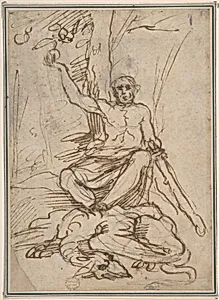
The Apples of the Hesperides, from "The Labors of Hercules"
Medium
Pen and brown ink over black chalk on light tan paper
Dimensions
8-3/16 x 5-7/8 in. (20.8 x 14.9 cm)
Classification
Drawings
Department
Drawings and Prints
Museum
Metropolitan Museum of Art, New York, NY
Credit
Gift of Cornelius Vanderbilt, 1880
Accession Number
80.3.63
Rights
Public Domain
Tags
Art Historical Context
This delicate drawing, *The Apples of the Hesperides, from "The Labors of Hercules"*, captures one of the hero's mythic feats: stealing the golden apples guarded by the Hesperides nymphs in a distant garden, as his eleventh labor set by King Eurystheus. Created by an anonymous Italian artist from the Roman-Bolognese school in the 17th century, it reflects the era's fascination with classical mythology, blending heroic narrative with Baroque elegance. Such preparatory sketches were vital in workshops, serving as studies for larger paintings or frescoes that adorned palaces and churches across Italy. Executed in pen and brown ink over black chalk on light tan paper—measuring just 8-3/16 x 5-7/8 inches—this intimate work showcases the precision of the Bolognese tradition, known for its refined line work and subtle tonal modeling. The chalk underdrawing provides a soft foundation, while the ink adds dynamic hatching and contours, evoking movement and depth in a compact format. Bologna's artists, influenced by the Carracci, excelled in such techniques, making drawings prized collector's items. A gift to the Metropolitan Museum of Art from Cornelius Vanderbilt in 1880, this piece invites visitors to ponder Hercules' enduring symbol of human triumph over the divine, preserved in its raw, preparatory beauty.